Wednesday, November 14, 2007

Day 102 - The Last of the World's Fair


I was fortunate enough to be a guest at the Long Island City Business Development Corporation's annual luncheon today. It was held at Terrace on the Park in Flushing Meadows-Corona Park. This was a noteworthy event for me. Yes, I was pleased to have been invited by LICBDC. But there was something else. This was the only relic of any import remaining from the 1964/65 World's Fair that I had not been in.

In its current incarnation, Terrace in the Park is an event space and catering hall--with panoramic views of that glorious borough that is Queens. But the structure is also the former Port Authority Pavilion from the Fair. From outside, it looks vaguely like one of the Space Invaders (second row from the bottom, I'd say) in the futuristic style of the fair and of the day. But there is reason for the high-top, flat-top look. It was the Fair's heliport. Helicopters ferrying the city's business titans (and Port Authority executives, no doubt) to and from the fair would alight and take off from here.

Despite still being open to the public--Terrace on the Park is the scene of an endless parade of retiring city officials' sendups and a not insignificant number of my friends' and colleagues' weddings--I somehow had not been in there yet. (I have even been able to climb to the top of the nearby off-limits NYS Pavilion--what most folks think of as the flying saucers or the things from Men In Black.) Other than scaling the outside of the Unisphere, I think I've conquered the Fair's main extant sites now.

Many thanks to LICBDC for the opportunity!

Tuesday, November 13, 2007

Day 101 - Midtown Modernism to Manganaro's


Had some time to kill today between a talk at the MAS and a food meeting at the Cornell Cooperative Extension on 34th Street. So I headed to B&H Photo on foot to get a new mic stand. This hazy late morning was perhaps the last mild day before the bitterness of autumn finally settles in on the City. I love the seasons--every one of them--but there is a bit of cruelty to offering a snap of springtime when it is likely to be followed immediately by autumn in earnest. Like an aperitif at the end of a meal.

As I wandered westward in the fifties past the Rockefeller tree enshrouded in scaffolding--like every other new or newly gussied edifice in the city these days--the monoliths of modernism along 6th Avenue yielded to lower-slung old taxpayers lining 8th and 9th Avenues. They're filled with modest businesses along the street that, in the old days, helped to subsidize the residential apartments in the 3 or 4 floors above. But they're all leaving. Ground floor shops and watering holes of long standing if questionable quality are closing up as their leases end and the buildings' owners realize the value that can be unlocked beneath their stately, if soot-smudged, brick facades. These are buildings from turn of the century New York when stone masons arrived by the hodful in steerage from Italy to erect handsomely clad buildings with decorative window lintels and pressed-tin-covered parapets that, on my of these old-timers, still cling to the top edges.

But now their time is past. Entrepreneurs rarely own, develop and run a business--or a building--on a single lot anymore. Aside from the odd sliver building that bucks this trend (see picture) most of these properties are being emptied, sold, and assembled by developers who are aggregating air rights and awaiting (or presaging) the transformation of the far west side. The most recent casualty close enough to me in my extended family of neighborhood joints for me to mourn a bit was the Collins Bar on the east side of 8th Ave, just north of 46th. Don't misunderstand: while this was a relatively young concern--less than 10 years--it was in a space that had all of the charms of a local gin mill for generations: darkness (true darkness, not loungy, candleflicker dark); dankness; improbably narrow with barely enough space to edge your way behind barstool patrons to the small dumbbell nook of tables at the back; tall, pressed tin ceilings; and a popcorn maker. Despite the cajun spiced salt and the high-end beers, this was still pure localism.

A little further down, a few relics which have hung on so long they're in danger of becoming, first, campy and, eventually, a kitschy throwback to yesteryear: Manganaro's Grosseria. Click here to read about the longstanding feud between it and the neighboring, not quite related, Manganero's Heroboy.

Saturday, November 10, 2007

Day 98 - Urban Detective In Training

I spent this chilly autumn morning with my buddy James (above) who was interested in becoming an Urban Detective Trainee. We met a group of other UDTs beneath the arch in Washington Square. There, the Municipal Art Society was hosting a tour geared at teaching young people about Jane Jacobs and her virtuous life in her neighborhood.

Before we set out we were given a map of the park and ambled around as a group looking at where people were gathered in the park and what they were doing. Some folks were playing with their dogs in the dog walk. One group was taking a tour, just like us, but not with as many young people. Some people were just sitting and talking on the benches (even though it was so cold!) and a lot of people were using the bathroom to wash themselves. (It turns out we learned some people live in the park.) Afterward, we came back as a group and completed two exercises. We filled out a grid with what things we thought a good park should have in it and, then, did the same thing for a good neighborhood. Here's some of what James came up with:

in a Park:
  • bathroom
  • flagpole
  • paths
  • dog area and dog fountain
  • people fountain
  • trash cans & ashtrays (so people don't throw cigarettes on the ground)
  • trees
  • benches
  • good lighting
  • play grounds

and in a Neighborhood:
  • a school
  • card store
  • arcade (didn't know kids James age knew what these were!)
  • entertainment
  • bowling
  • museum
  • clean stores
  • food store
  • theatre
  • subway station
  • firehouse
  • police station
  • army (oy...)
Good lists!

Then we set out with our guide from MAS and began walking around the neighborhood outside of the park to see some other strands of the urban fabric. We walked up to Washington Mews to see a quiet little enclave in the busier, bustling city outside its gates. It's a lovely space, a gem of a row of residences in old carriage houses. James and I saw something really cool: a tree or vine that had grown through the iron gates in front of one of the doors. We wondered how long the people had been stuck inside! And I was tickled that, incredibly, I had not been here myself, yet. But I wasn't sure this is what I wanted to show off to young Urban Detectives in Training as ideal urban living. (Though I was pleased that we got to go behind a gate and poke around in a place that otherwise seemed off-limits. Learning similarly at a young age has led to many, many years of me poking around in places I shouldn't have been. Including some subway tunnels. Sorry James' mom!)

We learned that the apartment buildings across the street at 2 Fifth Avenue has a fountain in its lobby that supposedly liberates water from the hidden watercourse below ground that used to be Minetta Brook and is now covered (UDTs take note!) by all of the streets and buildings and parks and trees-growing-through-doors that people have all built in New York in the last 400 years.

Unfortunately, after that the tour got a little boring. There was a lot of interesting adult stuff being talked about, but not so much for younger folks. Plus it was cold. We decided we'd head off to a bookstore a few blocks away to warm up and wait for James' mom. (Oh, and pore over Japanese graphic novels--James had a lot to teach me!)

On the way we thought we'd make the most of the rest of our times outdoors to polish our Urban Detective skills. (I always like to keep mine sharp as an Adult Urban Detective.) We saw some really cool things. First of all, walking back through the park we saw what must have been a discarded piece of fruit on the cobblestones beneath the arch that looked suspiciously like phosphorescent alien brain.

Then, just because we happened to be looking up in the air, we found what must have been the vestiges of an old tree house! There, about part-way up a tree in the park was--a mailbox! What a strange, fun thing to see!

Given the style of the mailbox, I think we assumed it was from the late-Levittown Suburban era, possibly early McMansion period. It was particularly odd to see an example of that style kitty-corner from the Federal style just a few yards away along Washington Sq. North.

I've been on a manhole cover kick lately and spending a lot of time paying close attention to the markings on steel castings that are either covers or sewer grates. (The Times scooped my story idea which I am in the middle of researching--about why so many of them are made in India now. Dispiriting, I tell you...) But this cover was one that I hadn't seen before. My guess is you won't find too many of them around the City. Note James' feet added in order to appreciate the scale...


Then it was time to learn about terra cotta. On the southwest corner of Washington Square Park is a fancy-pants apartment building over whose brass and copper awning is some prettily-colored baked tiles framing the window lintels and encircling the faux columns beneath some of them. James was more interested in splashing in puddles by this point. And given the temperature (and now the wet feet) we decided we'd proceed directly to the bookstore with now more boring distractions below our feet or above our heads.

But I'm really sad James wasn't with me just a couple of hours later when, after I left him with his mom, I found the most curious discovery of the entire day. And it made me feel good. Like an angel--or at least someone with special powers--was looking over us, every single day, in this busy, hazard-riddled city of ours.

Wednesday, November 7, 2007

Day 95 - Lunch in a Loading Dock

My friend Dory took me out to lunch for my birthday. I was asked if I could meet her near her office in the Garment District and given the choice of a Japanese curry joint or falafel in a loading dock.

As if she had to ask.

Pick-A-Pita does a brisk business in the back of a loading dock that you get to from the north side of West 38th Street. It looks like it was built out from where the old mailroom in this old garment building was. Florescent light banks line the ceiling like an office. The Snapple refrigerator competes with space for the 4 or 5 tables on asbestos tiles. "Garish" is an apt word. "Perfect," too. Falafel was excellently spiced (not too much cumin) if a little overcooked for my taste. But the ample, endless sides and condiments make it an even bigger treat.

Walking back to the subway, we passed the curry joint Dory had also suggested. Go! Go! Curry is just a few doors down. The Japanese owner is described as an obsessive fan of #55 on the Yankees, Hideki Matsui. How much so? Consider the shop's hours of operation:

Friday, November 2, 2007

Days Afield: Day 88 - Lost Between Pizza, Ploughshares & Pitchers


The lure of a rental car that was one-third the price of a Manhattan rental was just one thing that drew me to Philadelphia on Halloween. In fact, it was just one-third of the lure. The other two-thirds? A pizza pie from Tacconelli's before setting off on a road trip to see family down south.

Tacconelli's is a neighborhood joint tucked into the ground floor of a rowhouse in a working class neighborhood lined with three-flats. A little further east, down a gentle slope, Sommerset Street passes under I-95 before it stub-ends onto the old port's piers which reach arthritically into the Delaware River. The waterfront is still lined with industrial concerns but few, if any, seem still to rely on the river for much other than buffering them from development. The modest brick and woodframe houses up on the hill were home for the Polish and Italian dockworkers. And based on who I saw and heard sitting out on front stairs in the straining daylight, patiently waiting for trick-or-treaters with candy supplies in hand, easily calling to neighbors on the next set of stairs or across the narrow street, they're the same folks. It's their kids' kids now scampering from stoop to stoop filling bags with goodies.

Tacconelli's is unpretentious: pizzeria meets red-sauce sit-down joint, only without anything but pizza. It's a few steps up from the sidewalk into a faux-paneled vestibule and then into a 1980s era dining room with booths beneath a drop ceiling. Along one wall is a soda fountain and ice chest with a plastic rolling cart holding paper cups and plastic lids. It reminds me a bit of what a finished basement would look like if you turned it into a pizzeria.

Despite (or maybe because of) the lack of pretension, Tacconelli's is sometimes hard to get into. But reservations are needed not so much to hold a seat as to reserve a dough. They make only enough dough each day as is needed for the number of pizzas folks have reserved. Reserve 3 doughs for your party of seven and decide you want just one more gorgeous tomato pie? Sorry. Unless, of course, someone before you committed the treasonable act of taking fewer pies than they reserved. The menu and website both admonish diners to take what they've ordered and warn them not expect an extra.

Belied by the décor are brick oven masterpieces of exceeding simplicity. Each pie, individually made, has some combination of the following: dough, oil, cheese, tomato sauce. A “white pie” will be just oil and cheese on the dough with salt, pepper and liberal handfuls of garlic. The tomato pie, probably my favorite with a few anchovies added, is sauce on dough done to perfection. There are a couple of other equally simple combinations—and the standard toppings. But few, if any, are needed.

The brick oven into which the current pizza maker slips his works of simple artistry into is do deep that his wooden spatula has a handle that is nearly 20 feet long--so long that when it's at rest just outside the mouth of the oven the tip-end rests on a standing roller ten feet behind him to keep it from snapping. When feeding the spatula in to the oven to slip a pie in or retrieve a perfectly crusty one from it, the roller supports the handle gliding along behind the oven master. It's a beautiful one-man pizza operation. Stop by for a pie (call ahead!) and ask them if you can peek into the kitchen. If it's not busy, they'll simply step aside and let you ogle the place for awhile. Heaven on earth—in Philadelphia.

* * *

Most of you know how tickled I am by maps. And gadgets. So it's with some curiosity that I haven't embraced the advent of GPS and, for instance, chosen a cell phone with one if only for plotting my bicycle rides. But I also don't use them when I'm driving. I dunno.. seems a little like cheating. I pride myself in being able to find my way around just about anywhere with an admittedly keen sense of direction and a good, old-fashioned paper map. But I have to say that I was mesmerized by my friend Lucinda's on-board navigation system while we were making our way around Philly and its environs. For a little while after dinner, I really thought that it might be fun to be navigating my cross-country journeys with a dash-mounted map instead of having to pull over and consult a bound volume to double-check a coordinate or confirm a missed turn.

But then the next morning I got lost in central PA. Not the first time, frankly, and I hope it’s not the last.

I was cruising west along the Pennsylvania Turnpike waiting for my exit for I-81 south. A combination of insufficient caffeine levels and a rather robust two-fer of Bryan Adams on the radio is the likely reason that I realized I was zooming past my exit only as it was happening, doing 70. But, being unemployed and on a vacation within my vacation, there was little I could do to justify being angry. After all, what was my rush? I’d simply get off at the next exit and get back on in the other direction and get back on track. Ten miles passed. Then 10 more. Despite my best efforts, I was getting annoyed. Mostly it was this: I had no idea how far it was until the next exit—and I didn’t have a paper map; I forgot to take my road atlas from home. A keen sense of direction is a gift (as well as a developable skill) I’m proud to have, but it’s only part of what makes a successful trekker. I didn’t know if the exit was in 5 more miles or 25 more miles. Then when you add on the distance back to 81, it’d be double that. Two-x, x being an unknown value. Luckily it was only 5 more.

I scooted off the turnpike and found a gas station with a set of maps. I snuck a perusal and put back on the rack. Rather than go all the way back I found a route that let me triangulate to I-81 from where I was now. It required wending through some small roads but it was mostly a straight shot. And, secretly, I was pleased to be off the highway and tooling around in a new place.

Penna. Route 997 twists southward from the Turnpike through the great, fertile Cumberland Valley. It passes through a few small farming villages that seem like period pieces—further reinforced by Amish and Mennonite farmers who were out tilling their maize stalks into the ground for the winter on sled-plows drawn by small teams of 2 or 3 horses. Route 997 eventually merges with old US Route 11—one of the original Federal highways from the 1920s that picks a route from north to south from the Canadian border to New Orleans, largely through the north-south valleys paralleling the ridges of the Appalachians. I-81 runs nearly parallel to it for hundreds of miles, taking advantage of the same geographic advantages US 11 does.

Through these parts, US 11 is known as Molly Pitcher Highway. It was the nickname given to a Pennsylvania woman reported to have fought in the Revolutionary War beside her husband. In late June of 1778 in searing 100-degree heat, the Battle of Monmouth took place on the Jersey shore as the Continental Army attacked the evacuating British troops as they tacked north from Freehold. Molly’s husband was manning a gun or cannon was either wounded or felled by the heat as nearly half of the fighting force was that hot day. She took up his position and began firing on the British without missing much of a beat.

Historians seem to differ on whether or not Molly Pitcher actually existed or was, rather, a folklore composite of many women who contributed in heroic ways to the war effort. Whether real or apocryphal, Molly is memorialized along this section of Route 11 here in south-central Pennsylvania. There is also a rest stop on the New Jersey Turnpike, closer to the site of the battle, named for her. One woman with better documented contributions of heroism—Margaret Corbin—took position at her mortally wounded husband’s cannon against the British at Fort Washington two Novembers earlier. She herself was apparently wounded by enemy fire and became, after much haranguing, a pensioned invalid soldier—as a woman. Corbin’s contribution is similarly commemorated near the former site Fort Washington, just south of the Cloisters, at Margaret Corbin Circle. God help me if I ever do something important enough to name a road or rest stop after me.

The things you can learn from getting lost.

Sunday, October 28, 2007

Day 85 - Cincinnati, NY

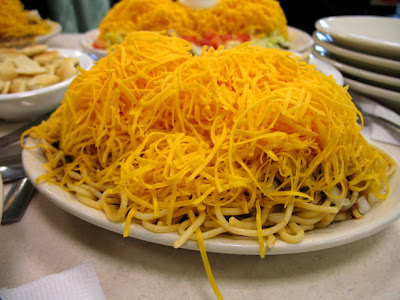
Photo credit: A bowl of 4-way Skyline Chili by Cathy Erway, noteatingoutinny.com

NYC being as cosmopolitan as it is, I've always been fascinated about where folks who are from somewhere else gather to be around compatriots. Almost everyone from someplace else longs for the comforts of home: a crowd with whom to root for the home team, people who speak with familiar cadence and terms of speech, and comfort food. New York must be filled with these sorts of places and I wanted to start visiting them.

So I recently put out a request to a few dozen of my more worldly friends here to ask them for suggestions.

The most intriguing spot I heard about was Edward's in TriBeCa. One night a month, Edward's creates a little Cincinnati in New York by importing a handful of classic dishes from the city of seven hills. Things like Montgomery Inn Ribs, LaRosa’s Pizza, and Graeters Ice Cream. Now, this was not, strictly speaking, what I was thinking of when I was asking about expatriate bars, but that may be why it captured my interest.

But first, I had a lot to learn about this fair city: its people, their food and, quickly, the geography. In particular, whether one is from the East LinkSide, or the West Side.

I pulled a seat up to a table with Ben Berman. Ben's a real estate development consultant from Cincinnati who works in San Francisco but just happened to be in New York on business and joined a friend from Cincinnati at Edward's.

“The east side associates itself with the eastern United States, essentially, I think," Ben told me. "And the west side seems to be more heartily Midwestern. So all the connotations of whatever that means for people in other part of the country are probably true for people who live there and the way they conceptualize themselves. They educate their kids in different places. They go to church in different places. They live in different cities when they graduate from college. I mean, it makes a very big different in terms of how you orient your life.”

He might be right about where folks settle when they leave Cincinnati. I interviewed more than a dozen people and all said they were from the East Side.

Brady Richards is an author from the Hyde Park neighborhood of Cincinnati, living in NYC after leaving his hometown for college 10 years ago. I asked him what characterized the typical Cincinnatian.

“We’re extraordinarily down to earth, humble, ouch!. I think there’s a strange groundedness to a lot of the mid west and Cincinnati is the heart of that, as they say. I’m also a meat and potatoes guy—it’s that kind of person. There's a real community feeling there. Growing up, it’s generations of the same families that you know everyone’s parents grandparents, that kind of thing. It’s a little harder to get here. But it’s nice to grow away from that in a way and try to establish that sort of feeling elsewhere."

At the next table over, Nicole Ginocchio, a new kindergarten teacher at a public school in the Bronx who also grew up in Hyde Park, was having dinner with a couple of other friends who recently moved to New York City after graduating from college. I asked her how she’d describe Cincinnati to someone who has never been there.

“The thing about Cincinnati is it’s kind of confused," Nicole said. “It’s in the Midwest geographically. But the people are this southern Midwestern hybrid. It is either like the most southern Midwestern town, or the most Midwestern southern town, ever. My dad always jokes that if they ask you where you went to school in Cincinnati, they don’t mean where you went to college, they mean where you went to HS, because they assume you never left, because everyone stays in Cincinnati.”

And then, a classic Cincinnati moment--or what must be. Brady had overheard my conversation with Nicole and leaned over and asked if she was related to the Ginocchio he went to school with.

"That's my sister!" Nicole said. And with that, the she and Brady caught up with a totting of houses bought, babies born, etc. "There you go," she continued, turning back to me. "Old Cincinnati right there!"

Which brings us to the food from Cincinnati. It's what seemed to unite all the Cincinnatians I met that evening: a nostalgia—or, at least, a craving—for particular dishes that are not easy to get away from the greater Cincinnati area: Montgomery Inn ribs, LaRosa’s pizza, and something called 3-way.

“A 3-way is three ingredients," Brady explained to me. "Spaghetti, chili, cheese. 4-way, you have you choice of either adding onions or beans. 5-way is adding both.”

Now the chili served at Edwards and in Cincinnati is different from what people in other parts of the country think of as chili. “I think that people who grew up with chili as its own meal probably do not understand--and possibly even hate--this being called chili because it’s just, in a way, meat gravy. You would never, in my experiences, order just a bowl of Cincinnati chili. But it’s much better as a condiment than regular chili is. While I’d love to a bowl of chili from Texas, or something like that, when you’re having a 3-way, the only way to do it is with Cincinnati chili.”

Even calling it meat gravy—which I had growing up in an Italian neighborhood here in New York—doesn’t quite capture Cincinnati chili’s hints of chocolate and cinnamon. From what I gathered, chili in Cincinnati is served in parlors as ubiquitous as pizza parlors are—or once were, anyway—in New York. Unlike New York’s history with pizza, though, Cincinnati chili parlor families opened many outlets for their respective brands. The two biggest are Skyline and Gold Star. Brady’s tastes have evolved over the years, it seems.

“I think like many of the chili parlors, started by a Greek immigrants to Cincinnati who had their own recipes. My history is a little shaky even though it’s written usually on the menus and the walls. My personal history is that I was a Skyline—well, I guess I was actually a Goldstar kid for most of my youth. But then when I hit HS it was skyline all the way and it still it. It’s the most prevalent one. There’s one in every neighborhood pretty much.”

Edward Youkilis is the owner and namesake of Edwards and the instigator of these monthly reunions. He left Cincinnati in 1969. On this night, we were watching his nephew Kevin prepare to help the Boston Red Sox sweep the Colorado Rockies in Game 4 of the World Series on a big screen TV. In between innings and bites from a rack of Montgomery Inn ribs, he shared some of the thought behind Cincinnati Nights.

“We started the Cincinnati night about 3 years ago with a friend of mine who worked here named Seth Workman and I started it together. He’s also from Cincinnati and was the manager at the time. And we started small and we started realizing that there are a lot of people who moved here from Cincinnati or worked in Cincinnati who missed a lot of the very specific food they were associating with Cincinnati. So little by little we developed this menu. And I think tonight is our 37th or 38th Cincinnati night here, so we’ve had quite a few of them.”

Toward the back of this narrow restaurant I found Megan Schlegel, an event planner for a large department store and Alexi Tavil, a personal assistant. They met through work and when they realized they were both expatriates, they decided to get their other Cincinnatian friends together to check out the scene at Edwards. It just took them awhile to find the place.

“We’ve been trying to find this place for two years," explained Megan. “I was googling it and could not figure it out. We had a friend who was here on an internship and told us about it. And we could never figure it out where it was and we just did. And I’ve been looking forward to this all week.”

Alexi moved out of Cincinnati about 5 years ago and her family subsequently left the city as well. Does she miss it, I asked?

“Yes, it’s where I grew up. So I lived there for 20 years. You get used to a certain way of life and you get used to a certain kind of food, and then you go away and you can’t find anything similar. I was actually telling everyone before that my parents still will send me, when they go back to visit friends, they’ll buy me cans of Skyline, buy me bottles of Montgomery Inn, and they still have Graeters ice cream dry-iced and shipped to where they live in Washington.”

And how does Edwards compare to back home?

“You know, it’s good," Alexi agreed. "Tastes the same.”

And would they come back?

“Definitely. We’re talking about making our reservation for next month tonight.”

Megan and Alexi were surrounded by about 8 others who, in turn, were surrounding a few LaRosa's pizza pies. Were these their steady Cincinnati friends living abroad here in NYC, I asked.

Is this your kind of standard group of folks you know from back home?

“Actually we know each other very distantly through work, and so these are her friends and these are my friends," Alexi said pointing to each half of the table. "And we just came together.”

“Over Skyline,” crooned Megan.

“Over Skyline,” gushed Alexi, with a smile.

Thursday, October 25, 2007

Day 82 - Why do they call it Conduit Blvd, anyway?


I've been saying this a lot lately, but days like today remind of how lucky I am to have time that is my own. I saw an article in today's Metro NY on the Parks Department's proposal for part of the disused Ridgewood Reservoir. All I know about the plans is what I read in this article. In brief, it seems one of the basins may be filled in to allow for ballfields of artificial turf to be installed for active play. I don't yet have a strong opinion on it. My initial reaction is that natural green spaces should be maintained as such and perhaps adapted to allow recreation that complements their landscapes. I realized that this was one of the few parts of NYC's water infrastructure I still hadn't seen. But being concerned that there may be some significant changes in the offing, I wanted to have a look for myself. I was interviewing a manufacturer in nearby Ozone Park for a piece I'm working on, and since I had nothing to do afterward, I took the Q56 down Jamaica Ave. to Highland Park to have a look around.

The bus lets you of just past the Cypress Hills National Cemetery's perfectly aligned rows of headstones, and its rusting cyclone fence. It was gray and blustery late morning--perfectly autumn. Treetops were beginning to smudge from deep green to yellows and ochers, more vivid beneath the diffused light of an overcast sky. I slung my bag over my shoulder, leaned forward into the wind and marched up the path. Near to the top an old pair of staircases lead to top edge of the old reservoir. At some point it was probably a common thing to see folks from the neighborhood mount the hill and circumambulate the basins high up over the graveyards and apartment buildings. Along the path, the globes of all of the lamp posts--scores in total--are smashed to bits now, but I bet this was a lovely place to take an evening walk at one point. Might still be. Just darker.

The reservoir is fenced off. Some sections have been peeled back by folks intent on being inside. One such opening led to the top of the wall that bisected the basins--a path I was salivating over sneaking into. But nobody knew I was here, it was now raining pretty steadily, and the reservoir at mid-morning is a lonely, overgrown place. The stone walls sloping down into the undergrowth were slick. I used to be braver about such adventures. I'll be back, though.

One basin is filled partly with water and forms a makeshift wetland, fragmites and bullrushes looking more like Jamaica Bay than the Brooklyn-Queens border. The other is almost fully covered in cherry and willows and mulberry. At the edges are boarded up buildings that were the pump houses and valve chambers, in use until the mid-1960s. All are out of reach behind the fencing, ivy overtaking their thresholds.

The old reservoir sits atop the moraine that is the spine down the center of all of Long Island--from the East River to the East End. This is the furthest point south to which glaciers advanced during the last ice age. As glaciers pushed southward over tens of thousands of square miles, trillions of tons of soil, shale, boulders and sand were scraped up along its frontier, a Mother Nature-sized bulldozer. As the ice sheets retreated, all of that detritus was left to form the geologic feature that gave us the makings of many bridge-and-tunnel jokes. It also created a porous land form wonderfully conducive to naturally filtering and holding rainwater in underground aquifers.

The City of Brooklyn burgeoned in the mid-part of the last century and its collective thirst for clean water grew commensurately--probably moreso. At any rate, it outstripped the ability of wells and natural aquifers in Brooklyn to slake the thirst of residents, brewers, tanners, and gristmillers. Ridgewood Reservoir was commissioned around 1858 to hold waters brought in from Baisley Pond in what is today southeast Queens but was, then, still Nassau County. Water ran through an aqueduct--or conduit--westward from there into Ridgewood. The curiously named North and South Conduit Boulevards--familiar to anyone driving along the Belt Parkway to JFK Airport--framed the route from the pond to a point at the foot of the hill beneath the reservoir. From there, a steam pump forced water up the incline (the eponymous Force Tube Avenue, just south of Highland Park, marks its path) into the receiving basins where it would sit, ready to be used by Brooklynites. The height of the reservoir allowed gravity to do the rest of the work of distribution. After the greater City of New York came into existence in 1898 and Brooklyn was included in the more reliable Catskill watershed system, the Ridgewood Reservoir became vestigial.

If you can visit soon, it's a worthwhile spot to take in some fall foliage. And if you have a chance while you're out there, arrange to take the A-train out to Lefferts Boulevard. This is one of three routes to which I had not been to the very end of the line. Beneath the elevated, along Liberty Avenue from from Lefferts Boulevard all the way back to Rockaway Parkway, is one of New York's classic shopping streets. It's updated to reflect the Guyanese population that has largely filled in the modest row houses in Ozone Park. But it is a classic, disappearing scene in New York: a strip of locally owned stores providing a range of products and services for a diverse population. I don't recall a single chain shop, and saw quite a few old-time bakeries and fish markets. Residents appeared to have almost all of their needs met by this 20-block strip. It is magnificent.

Sunday, October 21, 2007

Day 78 - Tour de Bronx


It was a gorgeous day to be on a ride in the borough I've conquered least--the Bronx. Today was the annual 40+ mile Tour de Bronx ride sponsored by both Transportation Alternatives and the office of the Bronx Borough President.

With my time off, I assumed I'd get to see more of the Bronx to round out my knowledge. (I actually thought that abbut a lot of places in the city and have been surprised by how much less of it I've done; I imagined being out and tramping in a new neighborhood each and every day.) But on this ride, I realized I'd really seen quite a lot of the Bronx already. There were only a few legs for a few miles each that I hadn't really seen and said "oh wow" to myself on realizing I was riding through an area new to me. (Though nerdy and a little obnoxious, there aren't a lot of places in New York City left that I haven't seen before. It's a wonderful surprise when I can still be surprised by a street or a row of stores I hadn't seen before.)

For fun, I'll let folks try to guess which neighborhood was truly new for me.

The crew I rode with was as crowd-averse and anxious to get started as I was, so we set out ahead of everyone at all the different checkpoints. It was, for the most part, a benefit not to be caught up in the scrum of riders for the whole way, especially as they were delayed by over an hour beyond their scheduled times. But, to my great disappointment, being early meant that we were not able to ride along (on top of!) the Sheridan Expressway. The cop at the entrance wouldn't let us on until the main body of the ride was there. Rather than wait 90 minutes (though we did sweat it out for about 30, hoping we could sneak on), we found a parallel route and headed to Soundview. I'll be back next year to get a shot at that.

A modified version of the route I rode on appears here.

Thursday, October 18, 2007

Day 75 - Of Small Businesses, Olives & Sauerkraut


Dateline: Arthur Ave., THE BRONX

It's days like today that I relish being accountable only to myself. Woke up, checked e-mail, read the paper and did a little writing. Made a few phone calls and then packed up and headed out on an adventure.

Headed first into Brooklyn Heights to find some proprietors to interview for the story I'm doing on Worksman Cycles--to round it out from the customer angle. It was quite possibly the last day of indian summer, the sun streaming down Montague Street at a low, autumnal angle, warming my neck. Montague, despite the increasing incursion of chains and so-called format retail stores, is still a street of small businesses and individual propriety. I fell in step behind (I eventually deduced) the local dry cleaner, nattily dressed, who was greeting warmly and with recognition everyone walking toward him. He was like a little mayor of the block.

I was waiting for owners to show up at Monty's Pizza and Lassen & Hennigs and so killed som time reading The Onion and noshing at Montague Bagels (only so-so... too much like a sandwich roll). I wandered back up the street and got the brush-off at both places and sort dejectedly got on the train to Manhattan. I had business card proofs to pick up in Chinatown.

Walking east on Broome I passed a few restaurant supply stores and remembered that I wanted to try curing olives after reading about it in the Times yesterday. I went from store to store looking for gallon Mason jars. No luck. Went into about six places including the magical DiPaolo's Market who I assumed might have some in order to cure their own olives. Nada.

Late morning by this point. The morning mugginess never burned off as the sun climbed in the sky. A little uncomfortable for a stroll in jeans, but I kept nosing up and down blocks along and across the Bowery. On Mulberry, just north of Grand, a couple of old Chinese shop workers argued loudly across the way, squatting on the shady side of the street.

Over on the Bowery, I wandered into Balter, one of the last few old-time supply shops along the strip. These places are little more than storefront warehouses that are hums of human activity. At Balter, you make your way down a tall, narrow hallway with ancient, creaking floorboards. The fluorescent light flickers, barely making its way down past the stacks of boxed wares. It is a supremely satisfying, fleeting feeling to be a retail purchasers in a wholesale market. It feels select. Behind-the-scenes. If you're an educated consumer or connoisseur of your quarry, you might be able to avoid being fleeced. It's titillating.

Yet, no one down there is carrying gallon Mason jars.

I finally gave up and headed up to Teitel Brothers on Arthur Avenue for the fresh olives that I would cure, hoping I could also procure a couple of empty bottles from there or nearby. I took the 5 train up the Dyre Avenue line. For subway aficiandos, you'll appreciate why getting off at stations along this route is a treat. This branch is a former leg of the old New York, Westchester & Boston Railway that was converted to subway use in 1941. Its most notable features to non-railroad enthusiasts are its capacious stations that are spaced at commuter rail intervals instead of more tightly spaced rapid transit stops. From the Pelham Parkway stop, Arthur Avenue is a quick trip on the Bx12 bus.

I was rewarded!

Teitel Brothers is a treat to visit all by itself. This is an old-style market with a half-dozen brawny guys behind the counter fetching most things for you. The olives were piled in boxes in front of the store, underneath cheeses and sausage. Eight pounds of fresh olives? "No problem!" Two empty gallon jars? "No problem! But you gotta clean dem."

No problem indeed. I walked out with a shopping bag filled with olives and two more, each with an empty jar that had held a bunch of pickled gardenia recently transferred to serving dishes in the store. (And they still had the vinegar smell and streaks of roasted red paper and caulilower florets to prove it!)

And here I am, taking a break over coffee at a sidewalk cafe just up the street from Teitel Brothers. There are neighborhood regulars and Fordham students ordering biscotti or cannoli. In a few minutes, I'll hop back on the Bx12 and keep heading west over the Fordham Road Bridge into Inwood for a subway home. Not a bad prelude to making my first two gallons of homemade olives--and pickling my first homemade sauerkraut from a head of cabbage I've been meaning to use while I'm at it.

Saturday, October 6, 2007

Day 63 - Making Wine in Queens!


New York State’s latest experiment in viticulture is, right here, in New York City. That’s right. Long Island’s merlots have been gaining a grudging respect for their trademark oaky flavor. And the upstate Finger Lakes region is known for its award-worthy Rieslings. The next region to become well-known? How about Queens? As in New York City.

The Queens County Farm Museum is a 47-acre farm, the last one in New York City. And though it’s just blocks from the Nassau County border, it’s New York City, alright. The Q79 bus stops right out in front. It’s been a working farm since 1697 and open as a museum and educational institution since 1975. The museum helps to interpret the site and to teach the public about the City’s agricultural history. There are sheep and pumpkins and goats and hogs and corn and, says Gary Mitchell, the farm's operations manager, “We also have planted in 2004 an acre-and-a-half of vinifera—French wine grapes on American root stock. And we have 4 varieties here on the farm: We have chardonnay, merlot, cab franc, and cab sauvignon.

“Our first harvest in 2006 which we’d taken to our wine maker at Premium Wine Group in Mattituck, and from that we have a merlot and possibly a red blend will come out of that first vintage. The second vintage is in the middle of harvesting now. We took a chardonnay and a merlot in. So our second 2007 vintage will be a white and a red.”

In theory, it shouldn’t be that hard to grow grapes in Queens. Climatically speaking this area gets basically the same weather as the vineyards 100 or so miles east on the end of Long Island. But there’s something about the notion of growing wine grapes in New York City that still seems to defy nature—or at least the odds.

“Obviously, no one had planted grapes on the farm before," says Gary. "So there was a little bit of a mystery about whether the grapes would grow and flourish, but they have.”

Gary, in his 50s, is a theater actor turned farm manager and non-profit winemaker. And he sports the straw hat and reddened neck to prove it. He was showing me around his vineyard a few weekends ago. The farm decided to grow wine grapes as an experiment to see what was possible—and as a way of creating more programs that would appeal to adults.

Hence, winemaking. Or wine-growing, really. The grapes are grown here. But modern-day winemaking requires specialized equipment like automated grape presses, large fermentation tanks, and a bottling facility. The Queens County Farm Museum has none of this. It doesn’t even really have enough grapes to get a sufficient volume of wine for modern day equipment. So Gary spoke to a fellow wine maker out east on Long Island.

“And his suggestion," Gary continued, was that because of minimum size of fermenting tanks and because of the amount of wine we actually wanted to make—which is by far the smallest quantity anyone makes with him, about 350 cases—it was decided very early on that we would have to source grapes from other LI growers. Any one variety here wouldn’t sufficient to make enough wine because it is only about an acre-and-a-half to two acres.

“Once we saw that we had some quality fruit. We’ve purchased some grapes and mixed ours in there so there’ll be a nice heavy percentage of our own grapes in the bottle, and make wine under the name Queens Farm Vineyards.”

Alice Wise of the Cornell Cooperative Extension in Suffolk County has been conducting viticulture research for the past 20 years. She says she is pleased with what the Queens experiment will mean for raising awareness among City residents of the importance agriculture retains in the region. Besides, she says, “New York City is probably the most important wine market in the world. Why wouldn’t we want to have some examples of local wines here?”


Back on the farm, a couple of Gary Mitchell's farmhands were snipping some examples of cabernet franc and cabernet sauvignon grapes in order to introduce a dubious public to Queens’ possible future as a winegrowing region. The dozen or so rows of vines are all covered with netting that protects the precious grapes from birds, including the farm’s own Guinea hens which had raided a couple of rows a couple of weeks earlier. Underneath one was Carmen Ortiz, a baby-faced 29-year old father of three from Spanish Harlem who makes the hour-and-a-half trip out here to help out on the farm. Gary hired him earlier this summer after Carmen had come out here with his kids on a day trip to visit the farm.

Throngs of parents pushing strollers with rambunctious children in tow, some weighed down with bagfuls of apples, made their way up the farm’s main drive, from the entrance, past the hog pens and the sheep corrals. Some branched off for the obligatory corn maze. But an increasing number gathered around Gary and his assistant Carol Nicolini-McCauley as they handed out some samples from bins of wine grapes. Gary and Carol described the process of growing and harvesting wine grapes.

The vines receive as many as five prunings throughout the season. The prunings ensure that only the best grapes remain during the months when their fermentable sugar is concentrating in the fruit. Pruning also ensures that air can circulate around the grapes. This reduces the likelihood that a scourge of wine grapes in this region--powdery mildew—will take hold and ruin the crop.

Deciding when wine grapes are harvested is determined by several factors. Most are scientific, the most important being the sugar content in the grapes which increases throughout the season to a peak point before the grapes begin to raisin on the vine. Close to picking, the sugar can change by the day, and part of the art of the vintner is finding the exact moment to harvest.

But there are also practical challenges, such as when a non-profit farm museum can locate enough labor to pick an acre or so of grapes by hand. Or if Gary’s pickup truck has enough payload capacity to haul all the grapes to the winemaker.

Carmen lugged up a couple of crates of clipped grapes and Gary asked the assembling crowed who wanted to crush some grapes. A chorus of "MEEEE!"s went up--largely from the adults.

Nancy Santiago took her shoes off and stepped into a steel vat about twice the size of a bathtub and filled up to her ankels with cabernet sauvignon grapes. "This is weird. It's like stepping on bubble wrap!"

Last month, the farm harvested their chardonnay grapes, followed by the merlot a week later. This year’s chardonnay which, as a white wine, requires less time to ferment, should be ready at roughly the same time that last year’s merlot vintage will be ready: early next summer. Orders for the few hundred cases will taken by the Queens County Farm Museum soon.

When one dubious visitor asked if the wine that was being made was any good, Gary offered a honest appraisal:

“Drinkable. Really nice. We’re not going to make an award-winning wine. But we’ll make a decent tasting wine that you can take home for dinner and not be embarrassed.”